With BC deciding to go to permanent summer time, there is a lot of interest, and a lot of discussion about time zones.
Part of my husband’s family comes from County Wexford in Ireland. If you lived in Wexford County in Ireland in the first half of the 20th century, you could have easily had four time zones to deal all within the same county. Large for an Irish County, but small compared to Canadian cities – according to Wikipedia, Wexford covers an area of 2,353 square kilometres, which is smaller than the metropolitan area of Vancouver at 2,878 square kilometres.
Up until the 19th century the clocks varied from place to place. However, as the railways and telegraph started coming into play, it was important to get everyone on the same schedule.
Dublin Mean Time
In 1880, Dublin mean time was created. Dublin mean time (DBT) was 25 minutes and 21 seconds later than Greenwich mean time (GMT)
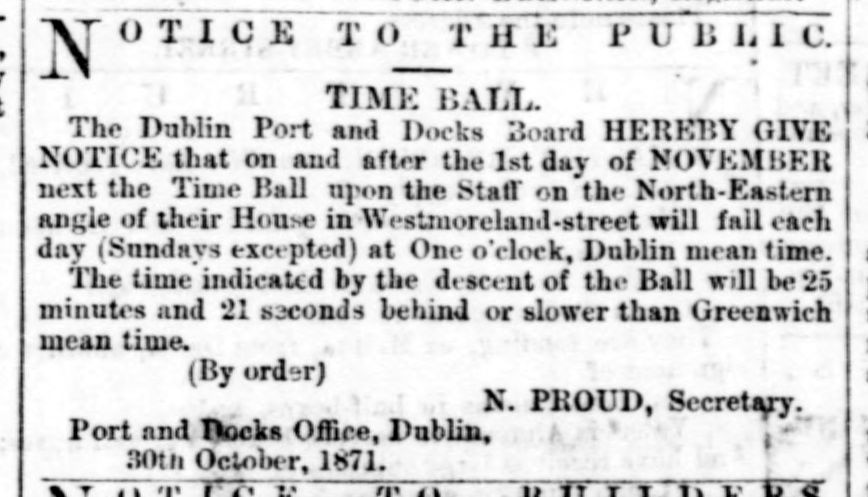
Greenwich mean time
In 1916, that changed.
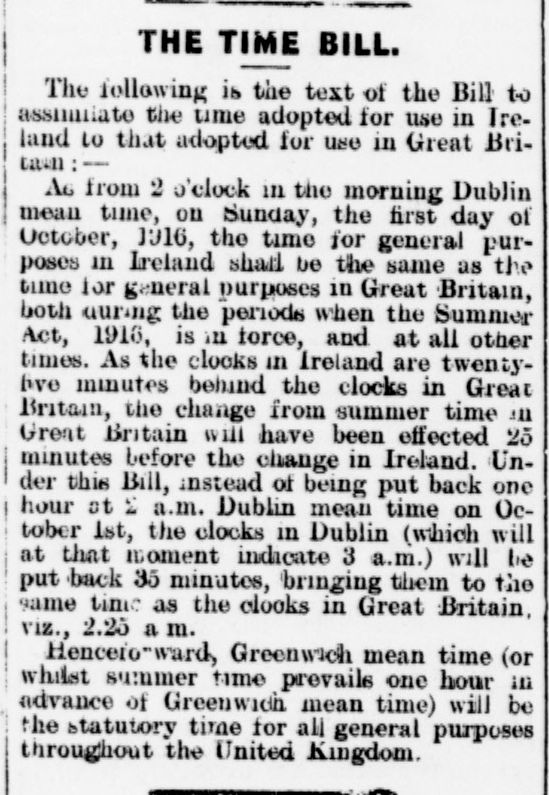
Great Britain decided to include “Summer Time”. In May 1916 when British Summer Time (BST) was introduced, At that time, Ireland was also being aligned with English time.
On Sunday, the first day of October 1916 the clocks changed. Britain at went back to GMT (when BST was ending), changing from 3:00 am to 2:00 am. Ireland changed its clocks to align with the rest of Britain. So, 25 minutes later, at 3 o’clock in the morning DMT the clocks in Ireland were to be set back 35 minutes to bring them to the same time as Great Britain (2:25 a.m.).
Sort of…..
Many churches decided they would not change until Sunday night – so that nobody would be late for church.

Some people and places decided to stay on Dublin mean time.
Apparently, those in Wexford County (and likely many other areas of Ireland too – but this post is about Wexford) decided on a case-by-case basis whether or not they would be on the “new time”.
According to Mangan (as quoted in Morrison1) Ireland now had four time zones.
- Greenwich time
- Greenwich time with summer time
- Old Dublin time
- Old Dublin time with summer time
To make matters more confusing, schools were advised to adopt the new time … but change the timings for everything by a half hour behind so that they were essentially working on the old time.
Generally towns moved to GMT, but not necessarily BST, and rural areas remained on DMT or GMT without BST.
And, even then, it wasn’t an easy transition for the towns. Enniscorthy decided, by a very close vote, to adhere to the old time (which is what they were now calling Greenwich time without summer time) in December 1916.

However, by April of the following year, Enniscorthy had embraced the new time with summer for businesses and factories. Churches were usually under the old time for Catholic churches and the new time for Protestant churches.
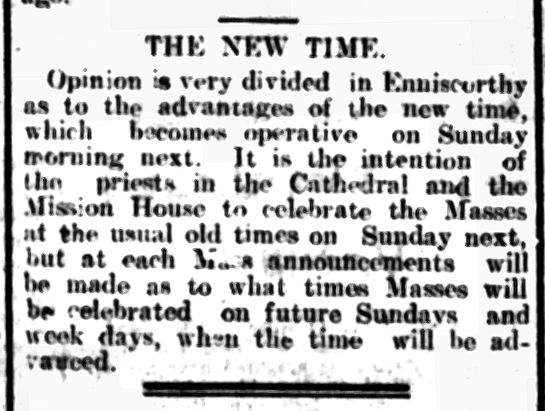
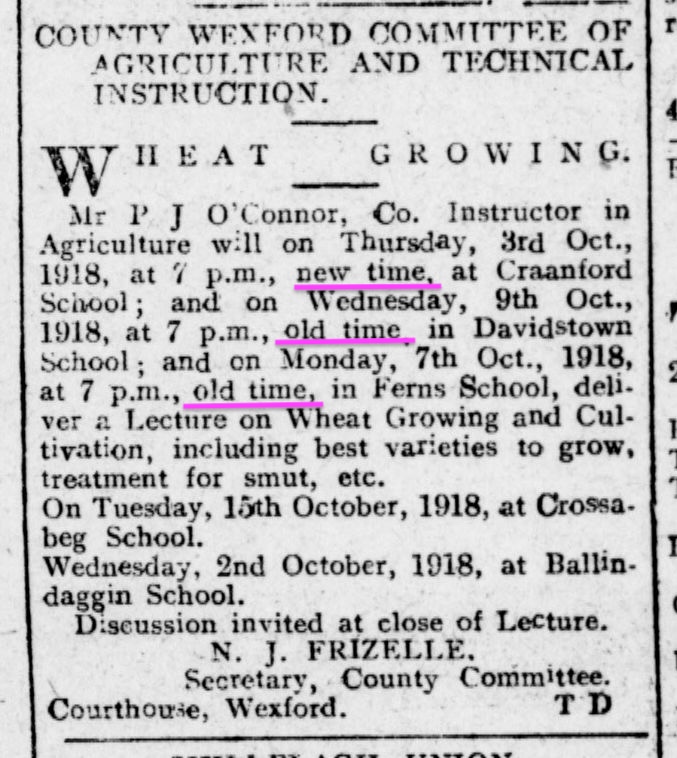
All of these new time / old time differences required newspapers to indicate whether something was taking place in old time or new time.
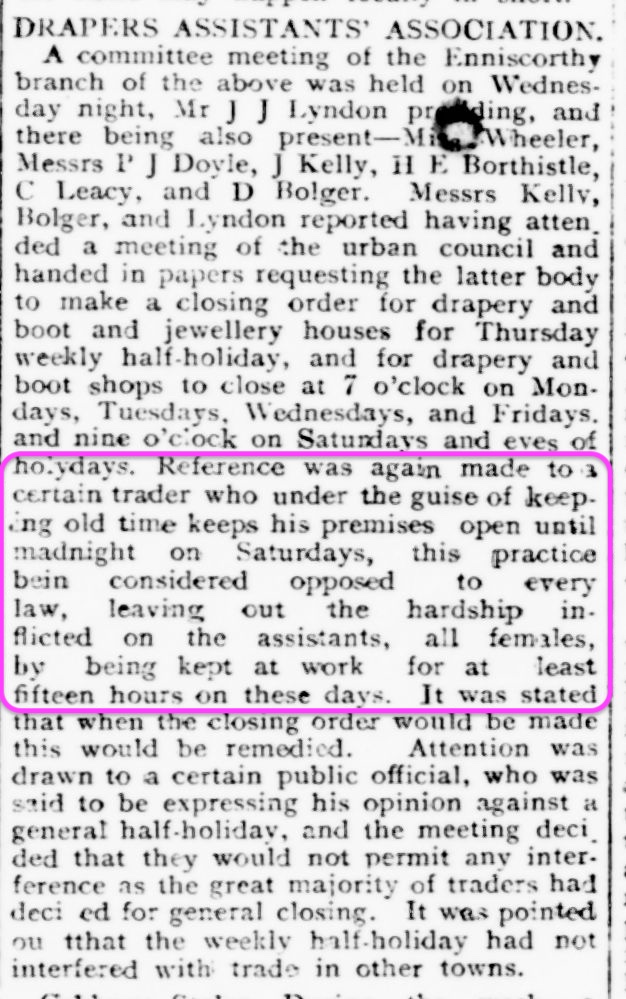
Some businesses took advantage of the confusion to increase the workload of their employees.
An ongoing issue
Problems with these different time zones did not end soon. In the 1930s there was an appeal on a football game as one team did not show up on time and forfeited the match.

And things continued to be different into the next decades. Time was still and issue in a 1954 court case where some witnesses provided their information as “old time”.
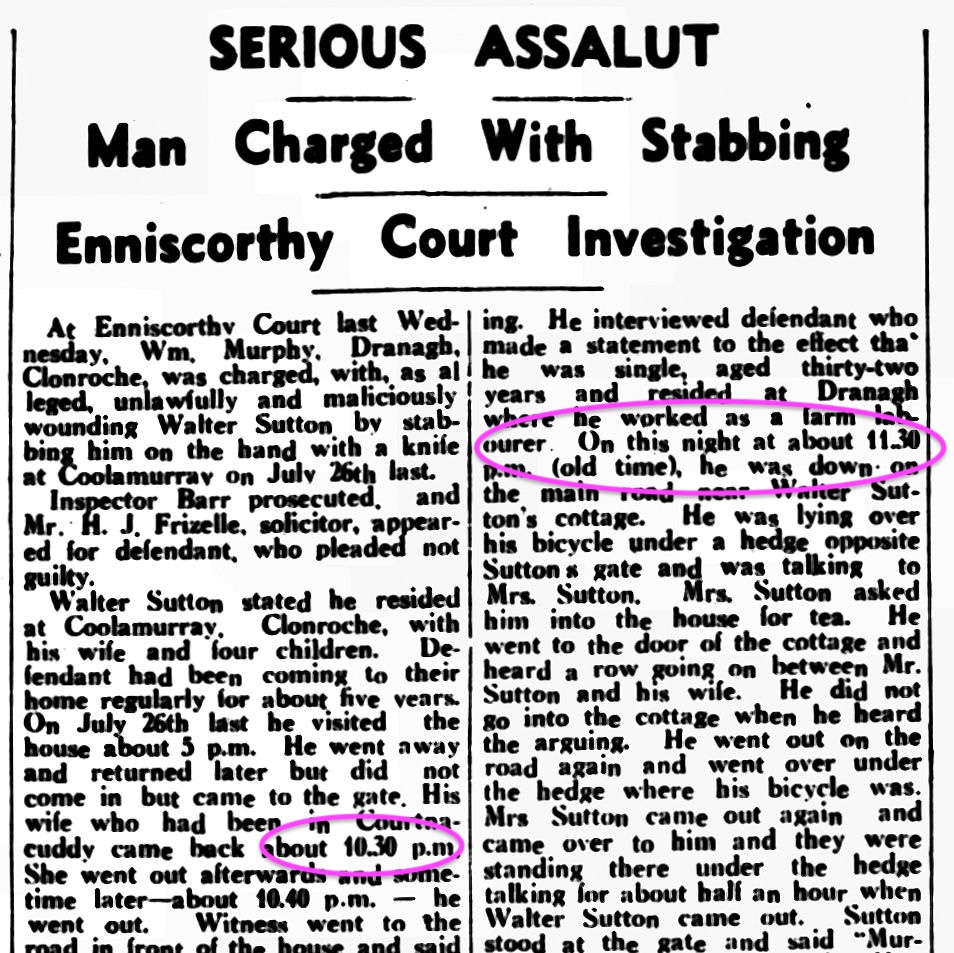
Eventually, 40 years after summer time was introduced, Castlebridge in Wexford decided to adopt it.

It seems eventually, everyone aligned with the new GMT and BST.
- Morrison, Eve (2020). Fighting time : temporality, time reform and the Irish Revolutionary present. https://ora.ox.ac.uk/objects/uuid:0d09613f-ccf3-4d80-aba2-bfcdf6340ac5/files/sj38607432 : accessed 30 March 2026. ↩︎